


Thoughtful Optimism
“If I had learned anything after years in the business, it was how little I could ever know about what the market would do tomorrow.”
-Chuck Schwab, founder of Charles Schwab1
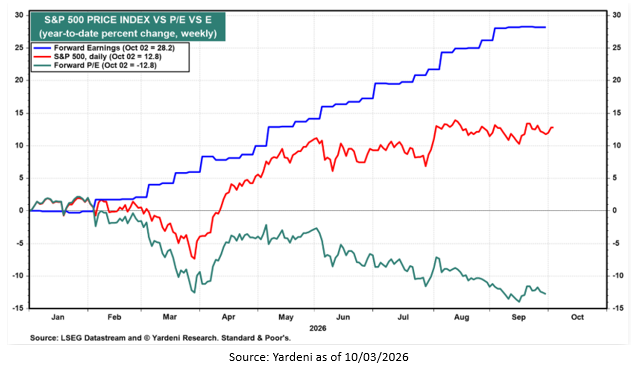
Equity markets posted a positive return of +2.3% during the 3rd quarter, bringing the S&P 500’s total return through the first nine months of 2026 to +12.8%2. While the return in the 3rd quarter was modest compared to the rally investors enjoyed in the 2nd quarter, it was impressive nonetheless given the rise in interest rates.
Corporate earnings expectations continued to grow faster than share prices, leading to a decline in the S&P 500’s forward price-to-earnings multiple from 23x to 19x3. Investors are now paying less for each dollar of earnings, reflecting concerns market participants may have. The chart below shows the earnings rising in blue, the price-to-earnings multiple falling in green, and the S&P 500 Index performance in red.
In our July newsletter, “Midyear Hydration Break”, we highlighted higher interest rates and elevated expectations for artificial intelligence (AI) stocks as potential challenges. Both remain central to the outlook today.
Rates
Interest rates took center stage in the 3rd quarter as investors adjusted expectations from anticipating cuts to preparing for hikes. In September, the Federal Reserve raised its policy rate 0.25%. This reinforced the new Fed Chair’s (Kevin Warsh) commitment to bring inflation back to their 2% target.
The challenge that Warsh has is inflation pressures originate from supply side shocks beyond the control of the Fed. Disruptions to energy supplies from the conflict in Iran as well as the ongoing Ukraine/Russia war have pushed commodity prices higher. For example, diesel is at record highs4. Diesel impacts countless critical industries including transportation, construction, and agriculture. As commodity prices stay higher for longer, consumers bear the ultimate cost via higher prices – an inflationary force.
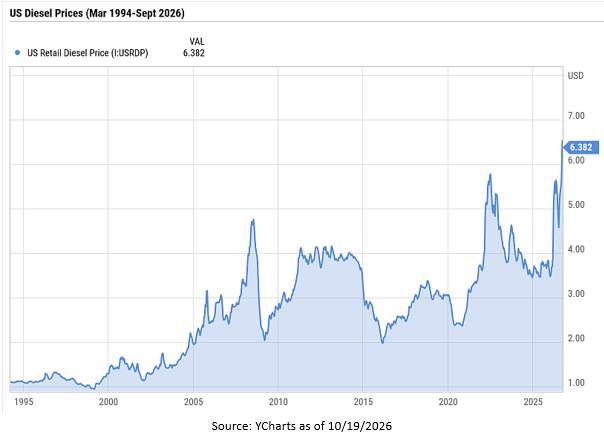
Unfortunately, raising interest rates cannot repair a damaged diesel refinery or reopen shipping lanes. However, higher rates can help slow down demand to prevent higher prices from spreading through the economy. The balancing act for the Fed is doing so without putting too much pressure on consumers, businesses, and other interest rate sensitive sectors who more directly feel the brunt of higher rates.
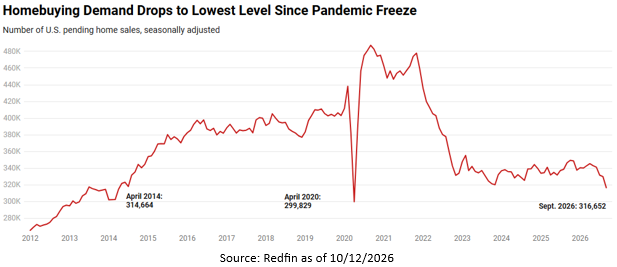
The negative impact of higher rates may be most directly reflected in the housing market. Coming into 2026 historically high home prices were already a challenge. Mortgage rates, which are priced off the 10-year US Treasury, have risen substantially due to higher long-term interest rates. The affordability issue has worsened.
Artificial Intelligence
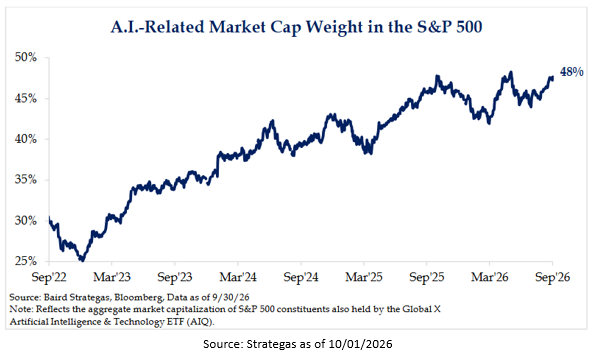
AI remains a dominant theme. Once bulletproof, AI is now being scrutinized. The fears center around if we are at peak growth, the durability of earnings, political and voter opposition, and competition particularly from China. The narrative oscillates from this is the greatest technology in the history of mankind to companies are overspending and we’re in a bubble. The answer likely lies somewhere in between.
There is no dispute that it’s been an AI-driven market. Many of the best performing stocks in recent years often had some relationship with AI, whether it was semiconductors, networking, electrical equipment, or power. We maintain exposure to various parts of the AI supply chain and believe the skepticism around AI is creating opportunities to introduce new ideas into the portfolio. The next few years may look different as in the past a rising tide lifted all boats as it relates to AI. Going forward, the market may be more discerning of winners and losers.
Ultimately, we believe the large language models (LLMs), such as ChatGPT, Gemini, or Claude will be commoditized where to most users it will be difficult to tell a meaningful difference between them. Over time, as the price of implementing AI declines, the benefits will likely be most impactful downstream to the adopters who are leveraging the technology to super charge their capabilities.
Looking Ahead
A lot of outstanding questions remain unanswered. How will the midterms play out? What is the path of interest rates for the next 12 months? How or will there be a resolution in Iran, and when? Paraphrasing, but as Chuck Schwab famously said in the opening quote, prediction is a fool’s game.
What we can control is building portfolios that have strong foundations, but also quickly adapt as conditions on the playing field change. The latter stands out in 2026 as we believe market conditions have warranted a nimbler approach. This is reflected in our core asset classes – equities and fixed income -in how we’re trading and our focus on tax management (where applicable).
Fixed income offers one of the more tangible opportunities in today’s environment. Yields are attractive across both taxable and municipal bonds. Investors do not need to go down the credit spectrum or extend duration far out the curve to find robust yields with good credit quality. Higher yields provide cushion if rates rise further, which is a much different scenario than coming out of Covid.
Within equities, we favor domestic over international, and are finding attractive opportunities in areas such as healthcare, aerospace and defense, as well as certain rate-sensitive corners of the market. We expect technology and AI-related stocks to continue to be volatile as the market seeks to calibrate fundamentals and expectations. This may create opportunities to add exposure. It is notable we are intentionally running modestly higher cash levels than recent history to have ample dry powder.
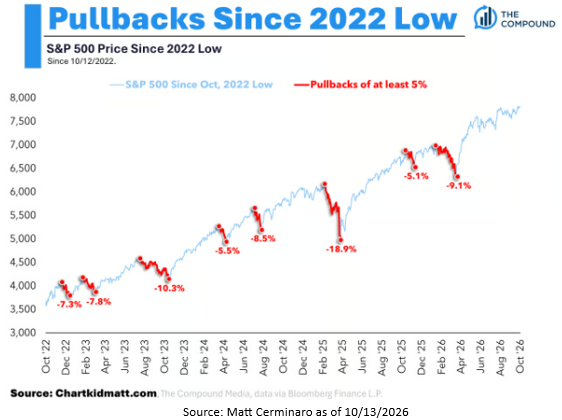
On October 12th, the equity bull market turned 4 years old, and the ride has been anything but smooth sailing. Investors have endured 8 pullbacks of 5% during this period6. It took 318 days for the S&P 500 Index to reach a new all-time high6. But since that date, the index posted 124 new all-time highs6.
Staying on course is not always easy. We give our clients a lot of credit for their trust in us to continue to navigate a volatile environment. It’s the greatest privilege to serve you, your friends, and family. We hope you have a wonderful fall.
Bryce Goldbach, CFA®
Partner, Co-Chief Investment Officer
10/19/2026
Citations
[1] www.schwab.com “Songs of Experience: Reminiscences of a Strategist.” Liz Ann Sonders. 9/3/26.
[2] www.strategas.com “Quarterly Review in Charts Thursday, October 1, 2026.”
[3] www.yardeni.com “US Market Call: Stocks Ignoring Bonds, For Now.” Ed Yardeni. 10/3/26.
[4] www.ycharts.com “US Retail Diesel Price as of 10/19/26.”
[5] www.redfin.com “U.S. Pending Homes Sales Sink Near 12-Year Low.” Dana Anderson. 10/12/26.
[6] www.chartkidmatt.com “Four Years of the Bull.” Matt Cerminaro. 10/13/26.
Disclosures
Past performance is not indicative of future results. The material above has been provided for informational purposes only and is not intended as legal or investment advice or a recommendation of any particular security or strategy. The investment strategy and themes discussed herein may be unsuitable for investors depending on their specific investment objectives and financial situation. Information obtained from third-party sources is believed to be reliable though its accuracy is not guaranteed, and Asio Capital makes no representation or warranty as to the accuracy or completeness of the information